
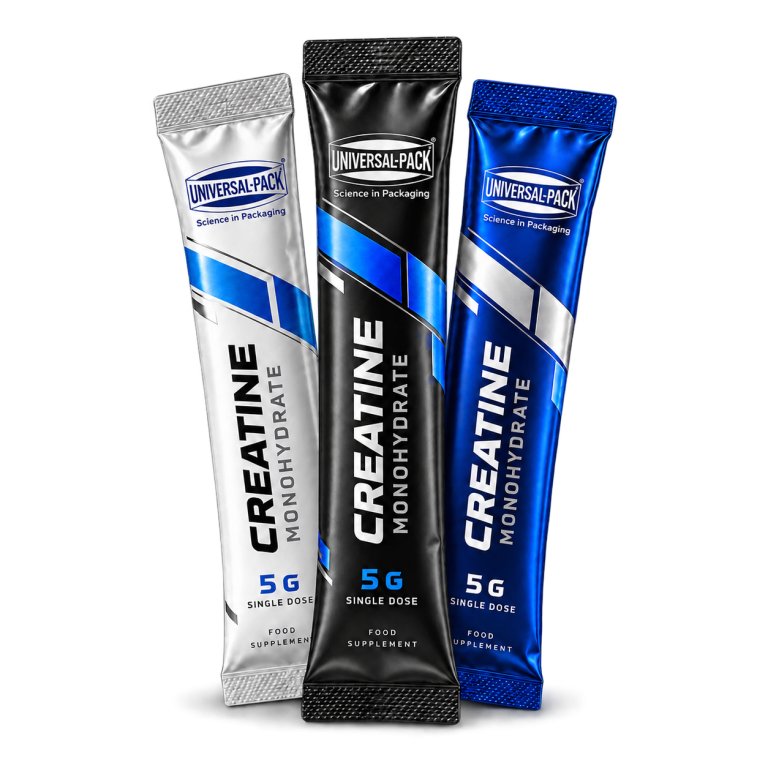
Whatever your production requirements, we have the packaging solution to match.


Built around the real behaviour of creatine monohydrate
Creatine monhydrate is not a free-flowing powder. Reliable packaging depends on maintaining controlled product feeding into the dosing system and managing the interaction between fine powder, auger rotation, target dose and pack geometry.

Auger dosing for highly non-free-flowing powder
Stable feeding before the dose is created
Control fine powder through filling and sealing
What to expect
Our process for your success
Your Requirements
We analyze your product, pack format, production targets and specific requirements to identify the most suitable packaging solution.
Technical Evaluation
Our Area Manager and Project Manager assess dosing, materials, performance and line configuration to define a reliable and efficient solution.
Project Definition
Technical specifications, machine configuration and project requirements are clearly defined before development begins.
Engineering & Testing
Mechanical, electrical and software engineering are combined with product and material testing to validate real production performance.
FAT
Factory Acceptance Testing verifies machine performance, pack quality and compliance with the agreed technical specifications.
Installation & Training
Our technicians manage installation, SAT, start-up and operator training to ensure a smooth transition into production.
Lifecycle Support
Remote assistance, spare parts and technical expertise help maintain machine reliability, efficiency and uptime over time.
Consulting
We support production optimization, new products, materials and formats to keep your packaging solution ready for evolving requirements.
Why Universal Pack for creatine monohydrate packaging?
Creatine monohydrate is a demanding powder application because reliable dosing cannot depend on gravity alone. The powder has to be actively and consistently presented to the dosing screw before an accurate portion can be created.
Universal Pack therefore develops the complete product path — from hopper and feeding conditions to auger dosing, filling, sealing and downstream control — around the actual creatine and required dose.
Auger dosing designed for difficult powders
Universal Pack uses electronically controlled auger dosing for non-free-flowing powders. Screw geometry, rotation parameters and dosing cycles are defined according to the required quantity and the behaviour of the actual creatine.
Product feeding is part of the dosing process
With highly non-free-flowing powders, a precise auger alone is not enough. Hopper geometry, agitation and product supply must maintain a consistent condition around the screw to reduce bridging and irregular feeding during longer production runs.
Process controls around a fine powder application
Depending on project requirements, the machine or complete line can integrate checkweighing, visual inspection, coding, Track & Trace, sieving and ionising systems. These technologies support a more controlled process around a product where fines and dosing consistency matter.
From single-dose creatine to automatic cartoning
The multilane packaging machine can be integrated with Universal Pack counting and cartoning systems when a defined number of stick packs or sachets must be grouped automatically. Bag-in-Bag can also be evaluated when primary packs require an additional sealed outer package.
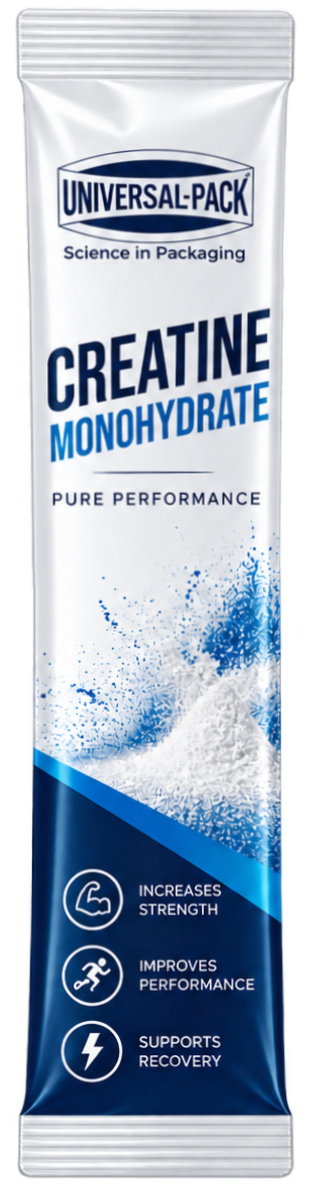
Examples of Creatine Monohydrate packages produced with Universal Pack machines.
Technical Project Assessment
Creatine monohydrate is treated as a highly non-free-flowing powder, so the project centres on product feeding, auger configuration, bulk density, dust behaviour, target dose and pack geometry. These parameters are evaluated together to maintain consistent screw feeding and repeatable dosing throughout production.
| What we evaluate | Key project considerations |
|---|---|
| What is the particle size distribution of the creatine? | Particle size and fines content influence powder compaction, dust generation and behaviour around the dosing screw. Representative product samples are therefore important when defining the auger configuration. |
| How non-free-flowing is the powder under production conditions? | The tendency to bridge, compact or feed irregularly is assessed because stable product supply to the auger is essential for repeatable dosing. |
| What are the bulk and tapped density values? | Density influences the volume occupied by the target dose, auger filling conditions, pack dimensions and the amount of product that must be displaced during each dosing cycle. |
| How should the auger be configured for the required dose? | Screw geometry, rotation parameters, dosing cycle and other settings are defined around the actual creatine, required quantity and expected production conditions. |
| How will consistent product feeding to the auger be maintained? | Hopper geometry, agitation and product supply are evaluated to maintain stable powder conditions around the screw and reduce bridging or irregular feeding during extended production runs. |
| Does the powder tend to compact during storage or feeding? | Compaction can change the condition in which the powder reaches the dosing screw. Product handling and hopper conditions are therefore considered as part of the complete dosing process. |
| How much dust is generated during dosing? | Fine creatine particles can disperse around the filling area. Dosing and machine parameters are assessed to limit unnecessary dust and reduce contamination near the pack and sealing surfaces. |
| What dose and filling tolerance are required? | Target weight, acceptable tolerance, bulk density and required output are considered together when defining auger settings and the overall machine configuration. |
| Is the product pure creatine monohydrate or a blend? | Flavours, sweeteners, electrolytes or other ingredients can change bulk density, particle size and feeding behaviour. Each formulation should therefore be considered as a separate dosing condition during technical assessment. |
| How stable is a blended formulation during feeding? | When ingredients have different particle sizes or densities, segregation can affect product homogeneity. The behaviour of the actual blend should be assessed under representative production conditions. |
| Which stick pack or sachet format is required? | Target dose, powder volume, pack width and length, opening system and branding requirements are evaluated together when defining the finished format and number of machine lanes. |
| Which packaging material will be used? | Laminate structure, moisture barrier, sealability, mechanical characteristics and compatibility with the required production conditions are considered when defining the packaging process. |
| What ambient humidity conditions must be considered? | Production-room humidity and powder storage conditions can influence the behaviour of fine powders during longer campaigns. Environmental conditions should therefore be considered together with product feeding and packaging requirements. |
| How many creatine formulations, doses and pack sizes will be produced? | Different products and doses can require changes to auger parameters, screw configuration or format parts. The SKU portfolio and expected changeover frequency therefore influence machine flexibility. |
| What cleaning and cross-contamination requirements apply? | Product changes, flavoured formulations, additional ingredients and campaign length are evaluated to define access to the hopper, auger and other product-contact parts and the required cleaning procedure. |
| Which in-line quality controls are required? | Checkweighing, visual inspection, coding, reject systems, Track & Trace and production-data management can be integrated according to the quality requirements of the project. |
| How should the finished packs be grouped and cartoned? | Required pack count, orientation, grouping and carton configuration are considered when the project includes automatic secondary packaging downstream of the multilane machine. |
Faq
Which packaging machine is suitable for creatine monohydrate?
Creatine monohydrate can be packaged on Universal Pack multilane stick pack and sachet machines configured with auger dosing for highly non-free-flowing powders.
Which dosing system is used for creatine monohydrate?
For this application, Universal Pack considers electronically controlled auger dosing. Creatine is highly non-free-flowing, so conventional volumetric dosing systems for free-flowing powders are not considered appropriate for the application.
Why is auger dosing suitable for creatine?
An auger actively moves the powder through the dosing unit rather than relying on natural gravity flow. Screw rotation and dosing parameters can be controlled according to the target dose and actual powder behaviour.
Why is hopper design important for creatine dosing?
Because dosing accuracy depends on the condition of the powder around the auger. Hopper geometry and agitation help maintain consistent product supply and reduce bridging or irregular feeding.
Can micronized creatine be packaged in stick packs?
Yes, subject to testing with the actual product. Fine particle size can increase dusting and influence bulk density and feeding behaviour, so the auger and product-feeding configuration need to be defined accordingly.
Can creatine blends also be packaged?
Potentially, yes. Flavours, sweeteners, electrolytes or other ingredients can change the physical behaviour of the powder, so every formulation should be included in the technical evaluation.
What creatine dose range can Universal Pack handle?
The required dose is evaluated together with powder density, auger configuration, pack dimensions and machine setup. The exact validated range should be confirmed for the specific application.
Is a stick pack or sachet more suitable for creatine?
Both formats can be evaluated. The choice depends on target dose, powder volume, pack dimensions, opening requirements and downstream packaging configuration.
How is creatine dust managed during packaging?
Product feeding, auger parameters and filling conditions are developed to limit unnecessary powder dispersion. Additional systems such as ionising devices can also be considered where relevant to the application.
Which films can be used for creatine packaging?
The laminate is selected according to moisture protection, sealability, mechanical requirements and production conditions. Alternative sustainable structures can also be evaluated through dedicated trials.
Can creatine stick packs be checkweighed automatically?
Yes. In-line weight control and reject systems can be integrated when the project requires automatic verification of finished-pack weight.
Can creatine stick packs be automatically counted and cartoned?
Yes. Universal Pack can integrate multilane primary packaging with counting and cartoning systems to automatically group the required number of packs into each carton.

Looking for the right packaging solution for your process?
Describe your application and requirements. We’ll review your needs and get back to you with clear, relevant answers.
