
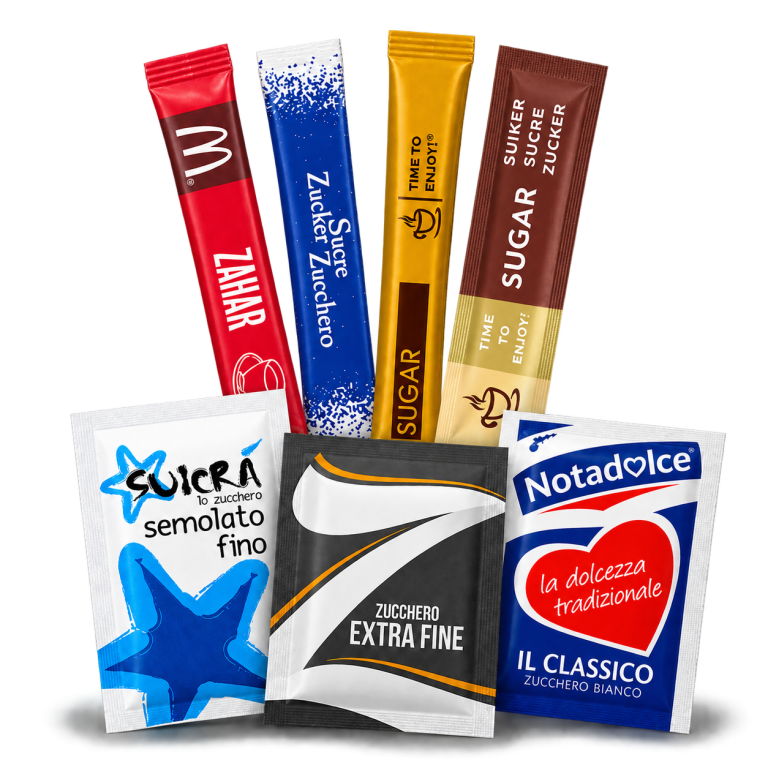
Whatever your production requirements, we have the packaging solution to match.


Make natural flowability work for the packaging process
White sugar is well suited to high-output volumetric dosing, but stable production depends on more than whether the product flows. Crystal size, bulk density, fines and environmental conditions determine how consistently each dose is formed and transferred into the pack.

Basculating dosing built for free-flowing sugar
Control crystals and fines through the filling area
From portion packs to automated carton counts
What to expect
Our process for your success
Your Requirements
We analyze your product, pack format, production targets and specific requirements to identify the most suitable packaging solution.
Technical Evaluation
Our Area Manager and Project Manager assess dosing, materials, performance and line configuration to define a reliable and efficient solution.
Project Definition
Technical specifications, machine configuration and project requirements are clearly defined before development begins.
Engineering & Testing
Mechanical, electrical and software engineering are combined with product and material testing to validate real production performance.
FAT
Factory Acceptance Testing verifies machine performance, pack quality and compliance with the agreed technical specifications.
Installation & Training
Our technicians manage installation, SAT, start-up and operator training to ensure a smooth transition into production.
Lifecycle Support
Remote assistance, spare parts and technical expertise help maintain machine reliability, efficiency and uptime over time.
Consulting
We support production optimization, new products, materials and formats to keep your packaging solution ready for evolving requirements.
Why Universal Pack for white sugar packaging?
Sugar and sweeteners are established Universal Pack applications. White sugar is specifically handled as a free-flowing product, allowing the packaging architecture to take advantage of its natural flow rather than forcing it through a dosing technology intended for difficult powders.
The result is a project centred on the interaction between crystal characteristics, volumetric dosing, multilane production and the required finished pack.
Basculating technology developed for free-flowing products
The Universal Pack basculating system uses oscillating volumetric cups with micro-adjustable dose control. While one cup is filled, the opposite cup discharges the measured product towards the pack, creating a continuous dosing sequence designed for free-flowing powders and granules.
Single-dose configurations from 0.1 to 100 g
Universal Pack’s free-flowing powder platform covers single-dose sachet applications from 0.1 to 100 g, subject to the specific product, format and machine configuration. Pack dimensions and lane configuration are developed around the required sugar portion and production target.
Product and laminate validation in the Universal Pack laboratory
Sugar, packaging material and machine configuration can be assessed together before final engineering. Internal tests help verify product behaviour, dosing conditions, machinability and sealing before the project moves into production.
From dosing to controlled secondary packaging
The primary machine can be complemented with pre-feeding, checkweighing, visual inspection, coding and automatic collection systems. For complete lines, Universal Pack’s patented counting technology can manage the required number of sachets or stick packs before cartoning.


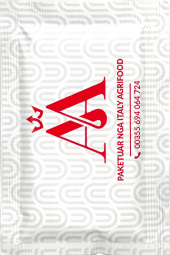



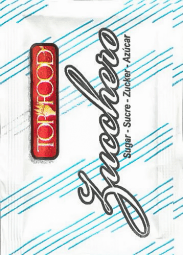




Examples of White Sugar packages produced with Universal Pack machines.
Technical Project Assessment
Crystal size distribution, bulk density, fines content, humidity conditions and required dose determine how consistently white sugar fills and empties from a volumetric dosing system. These parameters are assessed together to define the basculating configuration, pack volume and required production architecture.
| What we evaluate | Key project considerations |
|---|---|
| What crystal size distribution does the white sugar have? | Crystal dimensions and their distribution influence how uniformly the volumetric cups fill and discharge. Representative sugar samples help verify whether the product remains consistent throughout the dosing cycle. |
| How stable is the sugar’s bulk density between batches? | Basculating dosing measures product volumetrically, so changes in bulk density can change the weight delivered by the same cup volume. Batch-to-batch density consistency is therefore relevant when defining the dosing setup and expected tolerance. |
| How much fines content is present? | Fine sugar particles behave differently from larger crystals and may increase dust around the dosing and filling area. The proportion of fines is evaluated when assessing product transfer and machine cleanliness. |
| Does the sugar tend to cake under the expected production humidity? | Moisture uptake can reduce the natural flowability of sugar and promote agglomeration. Production-room conditions and product storage therefore need to be considered when validating stable feeding to the volumetric cups. |
| How should the basculating cups be sized for the required portion? | Cup volume and micro-adjustment are defined according to the target weight and actual bulk density of the sugar so that the required portion can be formed consistently. |
| What weight tolerance must each sugar portion achieve? | The required tolerance is assessed against the volumetric dosing principle, sugar density consistency and target dose to determine the appropriate operating and control strategy. |
| Can crystal breakage during product handling change the dosing behaviour? | If product transfer generates additional fines, the crystal-size distribution reaching the dosing system may differ from the incoming material. Feeding conditions are therefore considered when maintaining a consistent product profile. |
| How will sugar be supplied continuously to the dosing system? | Product pre-feeding is evaluated according to hopper capacity, upstream supply and required production autonomy so that the volumetric cups receive a stable and continuous product supply. |
| How should stray sugar crystals be kept away from the sealing area? | Product discharge, dosing tube position and filling conditions are defined to limit crystals and fines around the sealing surfaces and support consistent pack closure. |
| How much pack volume does the required sugar weight occupy? | Target weight and actual bulk density determine the physical product volume. This is used when defining sachet or stick pack dimensions and the required free space inside the finished pack. |
| Will more than one white sugar grade be produced? | Different crystal sizes or densities may require different volumetric settings. The expected product range is therefore considered when defining recipe management and changeover requirements. |
| Which laminate will contain the sugar under the intended storage conditions? | Sealability, mechanical resistance, moisture protection and machinability are assessed according to the selected pack format, storage environment and required shelf life. |
| What sustained output must the line achieve? | Required production capacity, portion size and pack dimensions are used to determine the appropriate multilane configuration and downstream handling architecture. |
| How will finished-pack weight be verified? | When automatic weight verification is required, an in-line checkweigher and reject system can be integrated downstream to monitor finished packs against the defined acceptance criteria. |
| How many sugar portions must be grouped in each secondary pack? | The required count and carton configuration determine the downstream counting, grouping and cartoning solution when primary packs need to be automatically packed in fixed quantities. |
Faq
Why is basculating dosing suitable for white sugar?
White sugar is naturally free-flowing, which allows volumetric oscillating cups to fill and discharge consistently. The basculating system uses this behaviour to combine dose control with high-output multilane packaging.
Does Universal Pack use auger dosing for standard white sugar?
For standard free-flowing white sugar, the basculating system is the reference solution. Auger dosing is more typically used for products with poor flowability, such as non-free-flowing or sticky powders.
Can both sugar sticks and traditional rectangular sachets be produced?
Yes. Universal Pack can develop stick pack and sachet configurations according to the required dose, dimensions, branding and production requirements.
Can hospitality-size sugar portions be packed automatically?
Yes. Single-dose formats are a core application of Universal Pack sugar machines. The final pack size and machine configuration are defined from the target weight, product volume and required output.
Can paper-based laminates be used for white sugar?
Yes, depending on the exact structure and required performance. Universal Pack machines can process structures such as PAP-PE and other suitable heat-sealable or alternative materials, subject to testing and project validation.
Can cold-seal material be used for sugar sachets?
Cold-sealable materials can be processed on suitable Universal Pack configurations. The actual material should be assessed together with pack geometry and required machine conditions.
Can the same line package white sugar and brown sugar?
Potentially, yes. Differences in crystal structure, density, moisture and flow behaviour must be evaluated because they can require different dosing settings or operating parameters.
Can sugar sachets be automatically checkweighed?
Yes. In-line weight control can be integrated downstream of the primary packaging machine when automatic finished-pack verification is part of the project.
Can printed coding and automatic visual inspection be integrated?
Yes. Inkjet or laser coding and automatic visual inspection systems can be incorporated according to the required traceability and quality-control architecture.
Can white sugar be packed using sustainable laminates?
Alternative structures such as PP, paper-based materials, PLA or Bio-PE can be evaluated. Final suitability depends on machinability, sealing performance and the required protection of the finished pack.
Can several sugar sachets be automatically counted into one carton?
Yes. Universal Pack complete lines can use patented counting systems to manage the required number of sachets or stick packs before automatic cartoning.
Can different sugar pack counts be managed on the same cartoning line?
Potentially, yes. The required counts, primary-pack dimensions and carton formats are considered when defining the operating range and changeover strategy of the downstream equipment.

Looking for the right packaging solution for your process?
Describe your application and requirements. We’ll review your needs and get back to you with clear, relevant answers.
