
Whatever your production requirements, we have the packaging solution to match.


Precision starts with the sweetener formulation
A sweetener sachet may contain only a small quantity of product, which makes consistency of the powder itself particularly important. Dose volume, density and blend behaviour all influence how reliably each portion can be formed.

Basculating dosing for free-flowing sweeteners
Small doses make powder consistency critical
Engineer the complete portion-pack process
What to expect
Our process for your success
Your Requirements
We analyze your product, pack format, production targets and specific requirements to identify the most suitable packaging solution.
Technical Evaluation
Our Area Manager and Project Manager assess dosing, materials, performance and line configuration to define a reliable and efficient solution.
Project Definition
Technical specifications, machine configuration and project requirements are clearly defined before development begins.
Engineering & Testing
Mechanical, electrical and software engineering are combined with product and material testing to validate real production performance.
FAT
Factory Acceptance Testing verifies machine performance, pack quality and compliance with the agreed technical specifications.
Installation & Training
Our technicians manage installation, SAT, start-up and operator training to ensure a smooth transition into production.
Lifecycle Support
Remote assistance, spare parts and technical expertise help maintain machine reliability, efficiency and uptime over time.
Consulting
We support production optimization, new products, materials and formats to keep your packaging solution ready for evolving requirements.
Why Universal Pack for sweetener packaging?
Universal Pack treats powdered sweetener as a dedicated free-flowing application rather than simply as another type of sugar. The basculating dosing system is specifically used for products such as sweeteners, stevia, fructose and free-flowing sugars.
Before final machine engineering, product and laminate can be analysed and tested internally so that dosing, pack dimensions and production configuration are based on the actual application.
Basculating dosing designed around natural product flow
For free-flowing powdered sweeteners, the basculating system provides volumetric dosing while supporting high-speed packaging. The final dosing configuration is defined according to the target quantity, bulk density and behaviour of the actual formulation.
From 0.1 g to larger portion formats
Universal Pack’s sugar and sweetener platform covers single-dose applications from 0.1 to 100 g, subject to product characteristics, pack format and machine configuration. This makes the relationship between dose volume and pack geometry part of the technical design from the beginning.
Test the sweetener and laminate before final engineering
The internal Universal Pack laboratory can analyse both product and packaging material before machine manufacture. This is particularly valuable for sweetener blends where density, flow behaviour or packaging material may differ from one project to another.
Add process control and automatic cartoning when required
Product pre-feeding, in-line weight control, visual inspection, coding and downstream collection systems can be integrated according to the project. Complete lines can also use patented counting technology to place the required number of sachets or stick packs into each carton.

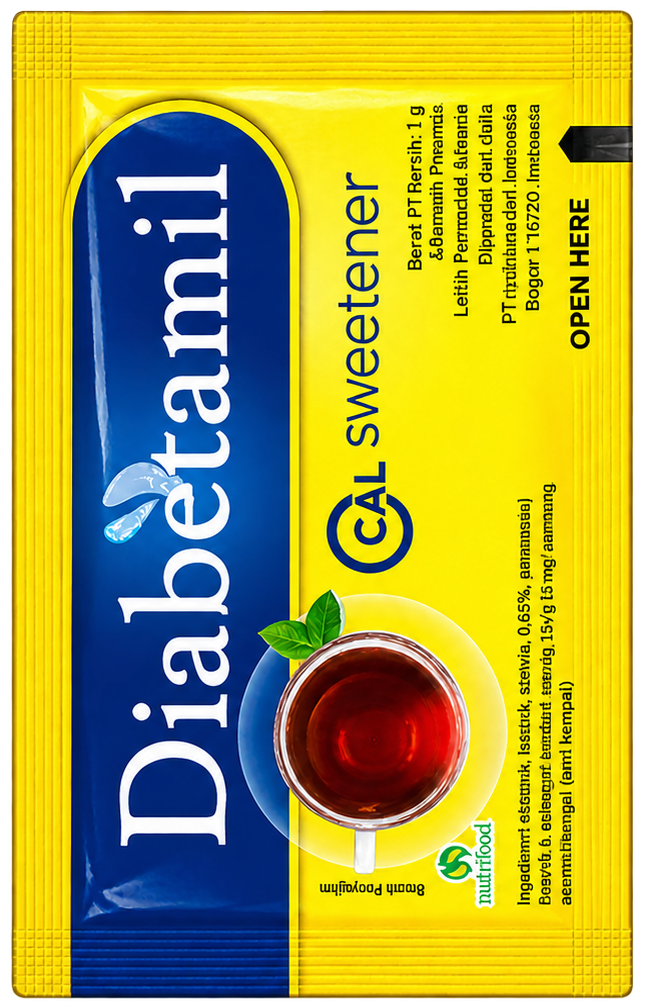
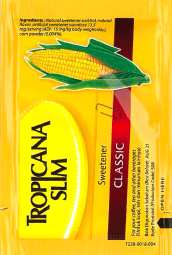

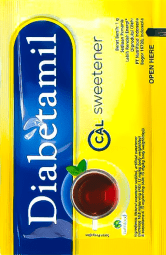

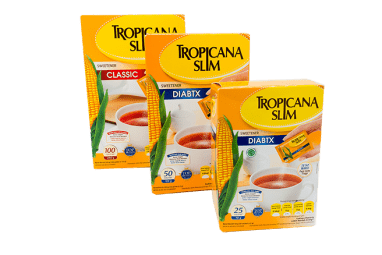
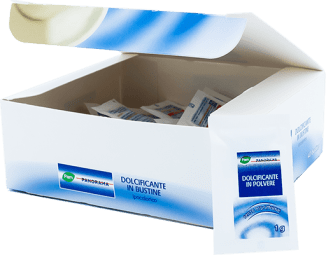
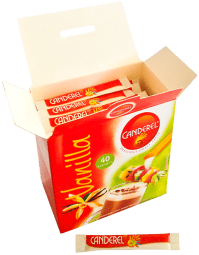
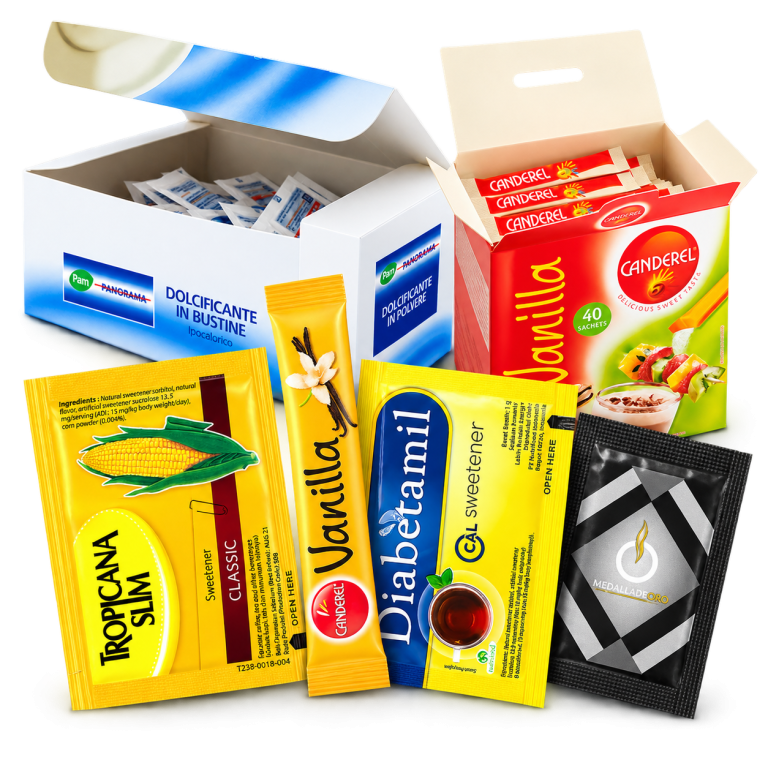
Examples of Sweetener packages produced with Universal Pack machines.
Technical Project Assessment
Sweetener composition, target dose, bulk density, particle distribution and blend stability directly influence volumetric dosing behaviour. These parameters are assessed together to define the basculating setup, pack volume and production-control strategy.
| What we evaluate | Key project considerations |
|---|---|
| Is the sweetener a single ingredient or a formulated blend? | The composition determines whether different particles, carriers or sweetening ingredients must remain uniformly distributed throughout product feeding and dosing. |
| How much product must each individual pack contain? | The target weight determines the required dosing volume and is particularly important for concentrated sweeteners where the portion may be significantly smaller than a conventional sugar dose. |
| How consistent is bulk density across the production batch? | Basculating dosing is volumetric, so a change in bulk density can change the weight contained in the same dosing volume. Density stability is therefore directly related to portion-weight consistency. |
| Does the finished sweetener remain consistently free-flowing? | Stable free flow is necessary for repeatable filling of the volumetric dosing system. Any tendency to bridge, cake or feed irregularly must be identified before confirming the basculating configuration. |
| Can ingredients within the blend segregate during handling? | Components with different particle sizes or densities may separate during transport or feeding. Blend stability should therefore be evaluated when uniform composition is critical to every individual portion. |
| What particle-size distribution reaches the dosing system? | Particle dimensions influence product flow and dosing-volume consistency. A broad distribution may also cause different fractions of the blend to behave differently during feeding. |
| How much fine powder or dust is generated? | Fines can disperse around the filling area and behave differently from the main product fraction. Their presence is considered when defining product handling and machine-cleanliness requirements. |
| Does the formulation show electrostatic behaviour? | Very light or fine particles may adhere to product-contact surfaces rather than falling freely. If this occurs with the actual formulation, appropriate product-handling measures can be evaluated. |
| Does humidity change the sweetener’s flow behaviour? | If the formulation absorbs moisture or tends to agglomerate, ambient and storage conditions can change its ability to fill the volumetric dosing system consistently. |
| What dosing volume is required for such a small target weight? | The relationship between target weight and bulk density determines the physical volume of the portion and therefore influences dosing-cup sizing and adjustment. |
| Will different sweetness strengths or formulations run on the same machine? | Different recipes can have different target weights, densities and particle characteristics, so each formulation may require its own validated dosing parameters. |
| How should the pack dimensions relate to the actual product volume? | The stick pack or sachet must provide sufficient internal volume for the measured portion while maintaining the required finished-pack proportions and filling conditions. |
| How should the packaging material protect the formulation? | Laminate selection is based on the sweetener’s sensitivity to moisture, required shelf life, sealability and the mechanical performance needed during production. |
| How will very small finished-pack weights be verified? | When automatic verification is required, the feasibility and specification of an in-line checkweighing system are evaluated against the actual pack weight and acceptance criteria. |
| How many portions must be transferred into each secondary pack? | The required count determines the downstream collection, counting and cartoning configuration when individual sweetener packs must be grouped automatically. |
Faq
Which machine is suitable for powdered sweetener packaging?
Universal Pack multilane stick pack and sachet machines can be configured for free-flowing powdered sweeteners using basculating volumetric dosing. The final configuration depends on dose, density, pack size and production requirements.
Why is basculating dosing used for sweeteners?
The system is designed for products that flow naturally into a defined volumetric dose. For a stable free-flowing sweetener, this allows the product’s own flow behaviour to support repeatable dosing and high-output multilane packaging.
Can very small doses of sweetener be packaged?
Yes. Universal Pack’s sugar and sweetener platform covers applications from 0.1 g per pack, subject to the characteristics of the actual formulation and machine configuration.
Does sweetener potency affect the packaging machine?
Indirectly. A highly concentrated sweetener may require a much smaller product quantity per portion, which reduces the required dosing volume and makes consistency of bulk density and formulation particularly important.
Can sweetener blends containing carriers be packed?
Potentially, yes. The complete blend should be evaluated because carriers and active sweetening ingredients may differ in particle size, density and flow behaviour.
What happens if a sweetener is not consistently free-flowing?
The actual formulation should be tested before the dosing technology is confirmed. Universal Pack uses basculating systems for free-flowing products and auger technology for non-free-flowing powders, so product behaviour determines the correct architecture.
Can both stick packs and sachets be used for tabletop sweeteners?
Yes. The final choice depends on target dose, product volume, desired pack proportions, branding and the required downstream process.
Can different sweetener strengths be produced on the same machine?
Potentially, yes. Each formulation must be evaluated for target weight, bulk density and flow behaviour so that appropriate machine recipes and dosing settings can be defined.
Can sweetener packs be automatically weight-checked?
Yes, where technically appropriate for the specific pack and acceptance criteria. Universal Pack can integrate in-line weight-control systems into sugar and sweetener packaging projects.
Which films can be used for sweetener sachets and stick packs?
Universal Pack lists heat-sealable structures such as PAP-PE, PAP-ALU-PE and PET-ALU-PE, as well as cold-sealable and alternative sustainable materials, subject to testing for the specific application.
Can a sweetener packaging line include automatic inspection and coding?
Yes. Automatic visual inspection, inkjet or laser coding and other process-control options can be integrated according to the project requirements.
Can sweetener stick packs be automatically counted and cartoned?
Yes. Universal Pack complete lines can integrate patented counting systems to collect the required number of stick packs or sachets before automatic cartoning.

Looking for the right packaging solution for your process?
Describe your application and requirements. We’ll review your needs and get back to you with clear, relevant answers.
