
Whatever your production requirements, we have the packaging solution to match.
Packaging performance starts with the way your pet food behaves.
Creamy texture, direct-from-pack consumption and demanding downstream processes make liquid pet food a highly specific packaging application.

Clean Filling for Creamy Recipes
Side-Fin Packs Made to Be Squeezed
Consistent Seals Before Retort
What to expect
Our process for your success
Your Requirements
We analyze your product, pack format, production targets and specific requirements to identify the most suitable packaging solution.
Technical Evaluation
Our Area Manager and Project Manager assess dosing, materials, performance and line configuration to define a reliable and efficient solution.
Project Definition
Technical specifications, machine configuration and project requirements are clearly defined before development begins.
Engineering & Testing
Mechanical, electrical and software engineering are combined with product and material testing to validate real production performance.
FAT
Factory Acceptance Testing verifies machine performance, pack quality and compliance with the agreed technical specifications.
Installation & Training
Our technicians manage installation, SAT, start-up and operator training to ensure a smooth transition into production.
Lifecycle Support
Remote assistance, spare parts and technical expertise help maintain machine reliability, efficiency and uptime over time.
Consulting
We support production optimization, new products, materials and formats to keep your packaging solution ready for evolving requirements.
Why Universal Pack
Your Recipe Is More Than a Viscosity Value
A chicken cream, a tuna purée and a nutritional paste may look similar in their final stick packs while behaving very differently inside the dosing system.
Animal proteins, fats, water content, thickeners, fibres and processing temperature can influence flow, product cut-off and dose consistency. Universal Pack starts from the customer’s actual formulation and selects the filling technology around its real behaviour.
The Pack Must Work with the Way the Product Is Consumed
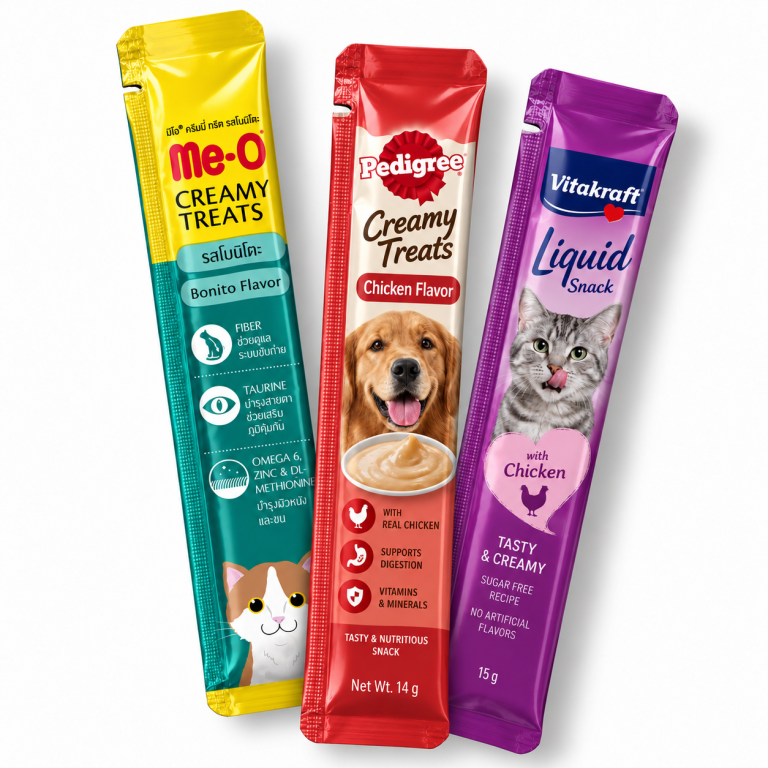
For many lickable pet treats, consumers do not empty the product into a bowl: they progressively squeeze it from a narrow stick pack.
This makes the package itself part of the feeding experience. Universal Pack can evaluate dose, usable internal volume, opening area and side-fin geometry together, developing the pack around how the pet food needs to move from the machine to the consumer.
Reliable Sealing Starts with Controlled Filling
With creamy pet food, what happens immediately before sealing can be just as important as the sealing station itself. A drop of product, grease or moisture reaching the sealing surfaces can compromise closure quality.
Universal Pack therefore considers nozzle behaviour, filling position, product cut-off and sealing conditions as one process. This becomes particularly valuable when the finished pack will subsequently undergo retort processing.
From Product Trials to Industrial Multilane Production
A new pet food formulation should not be engineered around assumptions.
Universal Pack can use product and laminate trials to understand dosing behaviour, optimise sealing conditions and evaluate pack quality before scale-up. The objective is to transform the customer’s formulation into repeatable industrial packaging conditions.
Looking for the Right Liquid Pet Food Packaging Solution?
Tell us about your recipe, texture, filling temperature, dose, pack format, laminate and any post-pack thermal process.
Universal Pack develops the packaging process around your liquid pet food, turning its real characteristics into a reliable stick pack, sachet machine or complete automated line.



Examples of Liquid pet food packages produced with Universal Pack machines.
Technical Project Assessment
Start with the pet food: texture, dose, pack geometry and downstream process define the packaging solution.
| What we evaluate | Key project considerations |
|---|---|
| What type of liquid pet food will be packaged? | Creamy treats, meat or fish purées, gravies, broths and nutritional pastes can require different dosing and filling conditions. The physical behaviour of the finished recipe is one of the first project inputs. |
| What creates the product texture? | Protein sources, fats, water content, starches, gums and other ingredients may influence product flow, dosing behaviour and product cut-off during filling. |
| How does the recipe behave at filling temperature? | Viscosity and consistency should be assessed under the actual production temperature range, as temperature can significantly change the way the product moves through the dosing system. |
| Does the product contain fibres or inclusions? | Type, maximum dimensions, concentration and consistency may influence product passages, valves, dosing technology and nozzle design. |
| What dose range and accuracy are required? | Nominal dose, permitted tolerance, product density and available internal pack volume help define the most suitable dosing configuration. |
| How cleanly does the product leave the nozzle? | Dripping, stringing or product tails can bring creamy pet food close to the sealing area. Nozzle geometry, dosing timing and filling conditions should therefore be evaluated together. |
| How will the pet food be consumed? | Direct licking from the stick, squeezing onto food or dispensing into a bowl can influence pack proportions, opening design and product evacuation. |
| Is a side-fin stick pack required? | Side-fin position, longitudinal seal, transverse seals, opening system and pack dimensions should be defined around the intended consumer format and dose. |
| Which packaging material will be processed? | Laminate structure, sealant layer, barrier properties, thickness and sealing behaviour need to be compatible with the product, final pack geometry and production conditions. |
| Will the closed pack undergo retort processing? | If retort is required, the selected laminate and pack design must be suitable for the customer’s validated thermal process. Relevant temperature, pressure and processing conditions should be considered during project definition. |
| Is residual air relevant to the thermal process? | For retortable flexible packs, residual air and headspace should be considered as part of the complete product, package and thermal-process assessment. |
| How many recipes and pack formats will share the machine? | Variations in flavour, texture, dose, stick dimensions and printed materials influence recipe management, cleaning requirements and format-change strategy. |
| What cleaning requirements apply? | Animal proteins, oils, product residues, recipe sequence and campaign duration help define product-contact accessibility and the most appropriate cleaning approach. |
| What sustained output must the system achieve? | Target packs per minute, batch size, operating shifts and downstream capacity determine the number of lanes and overall machine architecture. |
| How should finished packs be handled after primary packaging? | Inspection, checkweighing, counting, grouping, orientation, transfer and cartoning requirements define the required level of downstream automation. |
Faq
Frequently Asked Questions About Liquid Pet Food Packaging Machines
What types of liquid pet food can be packaged in stick packs and sachets?
Creamy treats, meat and fish purées, gravies, broths, nutritional pastes and similar formulations can be evaluated. The final machine configuration depends on the actual product behaviour, dose and pack format.
Which dosing system is suitable for creamy pet food?
There is no single solution for every formulation. Viscosity, filling temperature, texture, inclusions and required dose influence dosing-system selection. Piston pumps are particularly relevant for many liquid and viscous applications, while other technologies can be evaluated when appropriate.
Can Universal Pack produce side-fin stick packs for liquid pet food?
Yes. Side-fin configurations can be developed around the required pack width, length, dose, longitudinal sealing area and opening requirements.
Why are stick packs suitable for lickable pet treats?
Their narrow tubular shape makes them easy to open, squeeze and progressively empty. This can make the package itself part of the feeding or topping experience.
Can liquid pet food containing fibres or small inclusions be packaged?
Potentially yes. Particle dimensions, concentration and consistency need to be assessed because they can influence valves, passages, filling nozzles and dosing repeatability.
How is creamy product kept away from the sealing area?
Controlled product cut-off is essential. Dosing timing, nozzle geometry, filling position and available pack volume can be optimised to reduce dripping or trailing product close to the sealing surfaces.
Can liquid pet food stick packs undergo retort processing?
Yes, when the formulation, laminate, pack design and downstream thermal process have been designed and validated for retort use. Retort requirements should therefore be considered from the project-definition stage.
Why is sealing particularly important for retortable pet food packs?
Retort exposes the closed package to demanding process conditions. Seal temperature, pressure, dwell time, laminate compatibility and absence of product contamination are therefore important factors in producing a reliable flexible pack.
Can different meat or fish recipes run on the same liquid pet food packaging machine?
Yes, within the flexibility defined during engineering. Differences in texture, inclusions, dose and filling temperature should be evaluated to determine recipe settings, cleaning and any required format parts.
How are liquid pet food packaging machines cleaned between recipes?
The cleaning concept depends on the formulation, residues, production sequence and hygiene requirements. Product-contact accessibility and the appropriate level of cleaning automation are evaluated as part of the machine configuration.
Can Universal Pack test the customer’s pet food and packaging material?
Yes. Product and laminate trials allow dosing behaviour, sealing performance and pack quality to be assessed before industrial scale-up.
Can Universal Pack supply a complete liquid pet food packaging line?
Yes. Primary packaging can be integrated with inspection, checkweighing, counting, grouping, pack handling and automatic cartoning according to the required final configuration.

Looking for the right packaging solution for your process?
Describe your application and requirements. We’ll review your needs and get back to you with clear, relevant answers.
